

After the Rating: What Happened to Spark Savings USDT Vault
In March 2026, Credora published an independent PSL (Probability of Significant Loss) rating for the Spark Savings USDT vault. This case study documents what happened in the three months that followed: how capital moved, how the report was used, and what the data shows about the relationship between independent risk ratings and institutional allocation in DeFi.

The Challenge
DeFi lending vaults compete on APY. The number missing from most deposit screens is the probability of losing principal.
Spark Savings USDT vault was growing through early 2026. The vault offered yield backed by a diversified stablecoin collateral structure. It did not carry an independently quantified probability of loss. Institutional allocators considering a position had APY data: visible, real-time, comparable across vaults, and no standardized framework to size the risk against a position.
DeFi lending markets have built precise yield infrastructure. Risk infrastructure has lagged. An institutional allocator entering a DeFi vault in early 2026 faced the same information problem across every vault they evaluated: yield was quantified, default probability was not. In traditional credit markets, that asymmetry does not exist. A borrower without a credit rating does not access institutional capital at scale. A DeFi vault without a risk score faces the same constraint.
The result is a ceiling on institutional allocation. Capital that could enter does not. The yield is not the issue. The risk is unreadable in the format institutional due diligence requires.
The Solution
On March 1, 2026, Credora published a simulation-based risk rating for the Spark Savings USDT vault. The rating uses Credora’s PSL (Probability of Significant Loss) methodology: a probability framework that quantifies the likelihood a vault position loses more than a defined threshold under adverse market conditions.
The model runs Monte Carlo simulations across market scenarios: stress events, collateral price moves, liquidity contractions. Inputs are publicly documented. The methodology applied to Spark Savings USDT is identical to the one applied across every vault Credora rates, regardless of protocol relationship. No custom criteria, no adjusted thresholds for preferred counterparties.

That consistency is what makes the rating a useful comparison tool. An allocator reading the Spark PSL can put it next to any other rated vault on the same scale because the same model produced both.
The Impact Capital flows
At rating publication on March 1, 2026, Spark Savings USDT vault held ~$300M in TVL. Over the weeks that followed, capital entered.
By May 2026, TVL stood at approximately $1.4B, a ~350% increase over ten weeks.
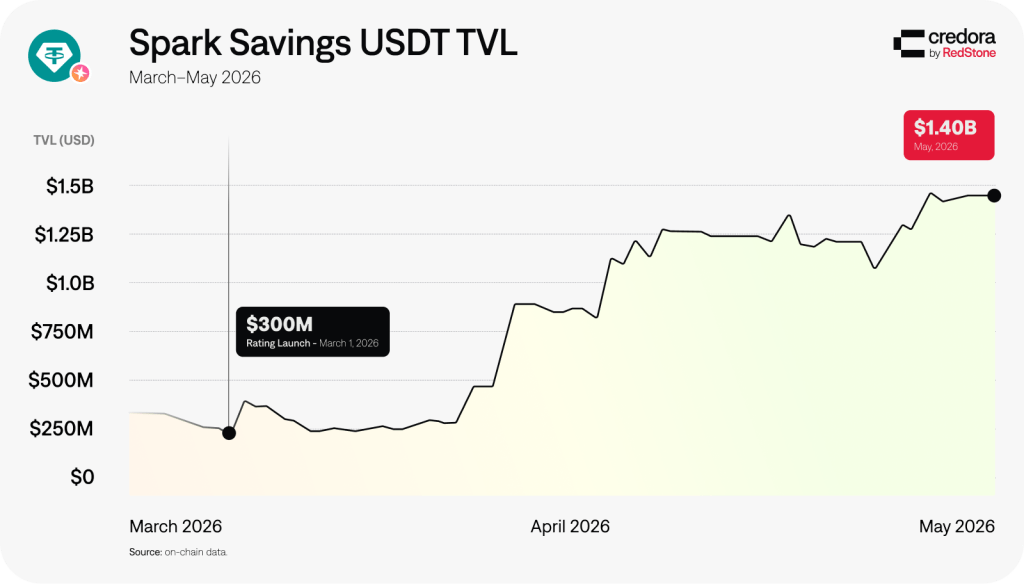
The growth was vault-specific. Comparable unrated stablecoin vaults on the same protocol did not show the same pattern during the same period. The rating publication date functions as a natural marker in the data: capital flow before and after a standardized risk score became available.
This is attribution, not proof of causation. A risk rating does not move capital mechanically. It removes a barrier to capital that was already willing to allocate but lacked the documentation to do so. The Spark data shows what happens when that barrier is removed.
Market demand signal
The rating report was downloaded over 1,000 times between March and May 2026. The download pattern is informative on its own.
Cumulative downloads grew at a steady rate through March and into April, consistent with ongoing due diligence by allocators at different stages of their evaluation cycle. Then on April 17, downloads spiked to 69 in a single day.
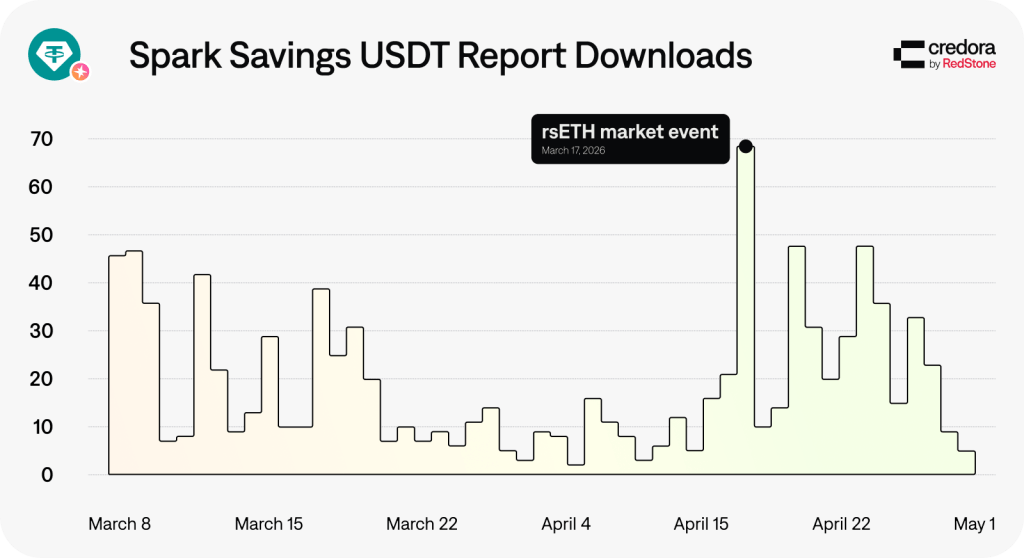
April 17 was the date of the rsETH market event. Institutions pulled the Spark report to check the vault’s exposure under stress. They were not looking for reassurance. They were running due diligence at the moment it mattered: a correlated risk event was unfolding and they needed to know whether their position was in scope.
Since publication, the Spark data has appeared in due diligence conversations with protocol teams evaluating independent ratings.
Summary
Spark Savings USDT had no independently quantified risk score. Credora provided one, using the same PSL methodology applied across every vault it rates. TVL grew from $307M to $1.39B in the months that followed. The rating report was downloaded over 1,000 times, with a spike during a live market stress event that showed the report being used for active due diligence, not passive discovery.
The data does not establish that the rating caused the growth. It establishes a documented sequence: a risk framework arrived, institutional activity followed, and the report was pulled when it mattered most. For protocols evaluating whether independent risk ratings affect real capital allocation decisions, that sequence is now on record.
FAQ
What is the Credora risk rating for Spark Savings USDT?
Credora assigned a PSL (Probability of Significant Loss) rating to the Spark Savings USDT vault on March 1, 2026. PSL quantifies the annual probability that a position loses more than a defined threshold under adverse market conditions. The full rating and methodology are available at reports.credora.network.
What does PSL mean in DeFi risk assessment?
PSL, or Probability of Significant Loss, is a probability framework Credora applies to DeFi lending vaults. It uses Monte Carlo simulations to model a range of market scenarios and outputs a probability distribution across outcomes. It is calibrated on the same default probability methodology used by traditional credit rating agencies, adapted for DeFi vault structures and on-chain liquidation dynamics. Documentation is available at https://docs.redstone.finance/docs/redstone-credora/
Does a Credora rating guarantee vault safety?
No. Ratings and data provided by Credora are for informational purposes only and do not constitute investment advice. A PSL rating quantifies risk probability under modeled scenarios. It does not eliminate risk or guarantee specific outcomes. Allocators should conduct independent due diligence before making any capital allocation decisions.
Spark Savings rating: https://blog.credora.network/2026/03/12/institutional-grade-risk-now-on-chain-credora-brings-credit-ratings-to-spark-savings/
Spark Savings report: reports.credora.network
Ratings and data provided are for informational purposes only. Not investment advice or a solicitation to buy or sell assets. Always conduct your own due diligence. Credora does not guarantee the completeness or real-time accuracy of any information provided. A full disclaimer is included in each risk assessment report published at reports.credora.network.
About Credora: Credora provides independent, data-driven risk ratings for on-chain finance. By standardizing risk measurement across assets, lending markets, and vault strategies, Credora enables transparent, resilient capital allocation. Through quantitative modeling, stress testing, liquidity analysis, and governance assessment, Credora converts complex protocol mechanics into comparable risk signals, supporting the sustainable growth and institutional adoption of on-chain markets.
About Spark: Spark operates as a two-sided capital allocator. On the ecosystem side, it borrows from Sky’s stablecoin reserves and deploys capital across DeFi, CeFi, and RWAs. On the user side, Spark packages that yield into accessible products like sUSDS and sUSDC, giving users seamless access to onchain, programmable income that is diversified, fee-free, and composable.