

DeFi portfolio risk: how to compare protocols on a single scale
Managing DeFi portfolio risk across multiple protocols requires something DeFi does not naturally produce: a common unit of comparison. Without one, every allocation decision defaults to yield as the primary signal. That is a problem. Yield measures compensation for risk, not risk itself.
The problem with DeFi portfolio risk evaluation by protocol
An institutional allocator building multi-protocol DeFi exposure faces the same structural issue at every step. Each protocol presents its own metrics. TVL, APY, audit count, time in production. Some publish security reports. Some do not. Most publish nothing about the probability of capital loss.
The result is a portfolio where individual position decisions are made with different information, different methodologies, and no shared vocabulary. A position in a high-yield lending vault and a position in a lower-yield established market cannot be compared on risk terms. They can only be compared on yield terms. And that comparison is missing the variable that matters most for capital preservation.
Traditional fixed-income allocators faced the same challenge before standardized credit ratings existed. A bond from one issuer and a bond from another had different maturities, different structures, different disclosed financials. Without a common rating scale, portfolio-level risk aggregation required each analyst to build their own framework. Traditional credit rating methodology solved this: one scale where a top-tier rating from one issuer carries the same risk meaning as a top-tier rating from another. The BIS has documented how that standardization changed the structure of fixed-income markets globally.
DeFi has no equivalent. Each protocol is evaluated in isolation, using that protocol’s own disclosures and the allocator’s own criteria. The portfolio that results is a collection of isolated bets with no shared risk language.
What a common scale makes possible
A standardized DeFi risk rating framework changes the portfolio construction question. Instead of asking “is this protocol safe enough?” in isolation, an allocator can ask: “what is the aggregate risk profile of my DeFi exposure at the portfolio level?”
That question requires three things: a consistent methodology applied across all protocols, a defined output metric that is comparable, and a scale that translates outputs into actionable categories.
Credora’s rating scale runs from A+ to D. The underlying metric is Probability of Significant Loss (PSL): the modeled probability that a depositor loses more than 1% of principal over a one-year horizon. Each protocol runs through 100,000 Monte Carlo simulations across five risk dimensions: collateral quality, smart contract exposure, oracle design, liquidity, and counterparty risk. The PSL output determines the letter grade.
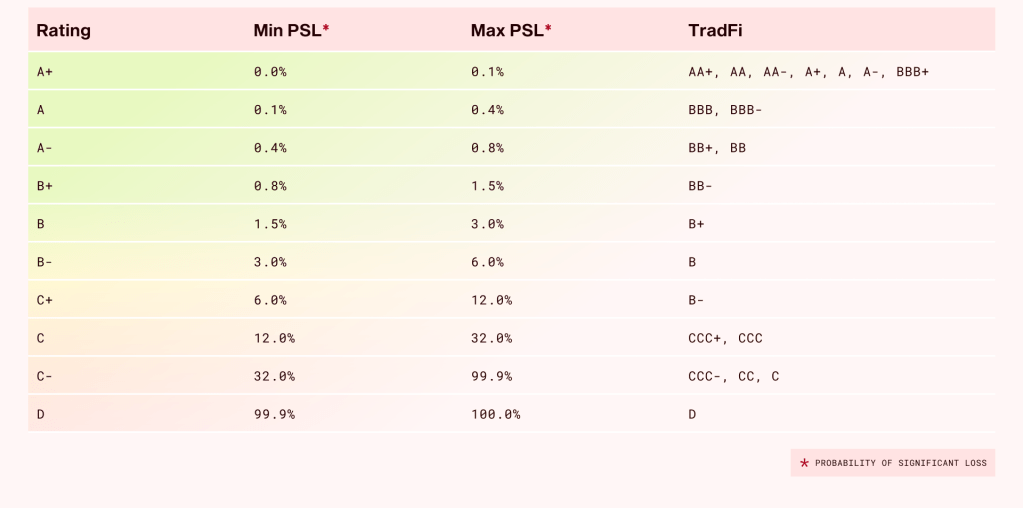
When every protocol in a portfolio has a PSL and a corresponding letter grade, portfolio-level risk aggregation becomes possible. An allocator can see that their total exposure is concentrated in B-rated markets, or that their highest-yield positions carry D-rated risk profiles that their mandate does not permit. These are conclusions that cannot be reached when protocols are evaluated individually with different frameworks.
A full explanation of how PSL is calculated is in What is PSL?, and the rating methodology is covered in What is a DeFi risk rating?.
How portfolio-level risk visibility changes allocation decisions
The practical consequence of a common scale is that allocation decisions change in character. They shift from protocol-specific due diligence toward portfolio-level risk management.
Consider an allocator with exposure across four lending markets: two at A-rating, one at B, one at C. Without a common framework, that allocator knows each position but cannot assess the portfolio as a whole. With PSL across all four, they can model aggregate loss probability, evaluate how adding a fifth position changes portfolio-level risk, and set explicit limits: no more than X% of capital in markets rated below A.
This is how traditional fixed-income mandates operate. Rating thresholds are embedded in investment policy statements. Concentration limits are defined by rating category. Rebalancing triggers fire when a position’s rating changes. None of this is possible without a common scale.
For institutional allocators, a common rating scale creates a shared language for counterparties. Risk committees and fund administrators can evaluate DeFi exposure using a metric they recognize structurally, even without deep protocol knowledge. The IMF has noted that the absence of standardized risk disclosure in crypto markets is a key barrier to institutional adoption.
A standardized framework is what separates a collection of individual protocol bets from a managed portfolio with a defined risk posture.
Key takeaway
DeFi portfolio risk across multiple protocols cannot be managed without a common unit of comparison. Yield is visible and uniform across DeFi. Risk is not. A standardized rating scale, anchored in a consistent methodology, makes multi-protocol risk visible on the same terms. Credora’s A+ to D scale, built on Probability of Significant Loss (PSL), is that common denominator: one scale across all protocols, usable at the portfolio level.
FAQ
What makes DeFi portfolio risk different from single-protocol risk?
Single-protocol risk is evaluated in isolation: one set of parameters, one set of failure modes, one due diligence process. Portfolio risk is aggregate exposure across multiple protocols, each with its own risk profile. Without a common scale, those profiles cannot be combined meaningfully and the portfolio’s overall risk posture stays invisible.
How does PSL function as a portfolio construction tool?
Probability of Significant Loss (PSL) is a single numeric output that can be compared directly across protocols. When every position has a PSL, an allocator can aggregate expected loss probability, set rating-based concentration limits, and model the impact of adding or removing positions.
Can a DeFi risk rating framework support institutional investment mandates?
Yes. Investment mandates define risk limits by category: maximum exposure to sub-investment-grade assets, concentration limits by rating tier, re-balancing triggers on rating downgrades. A standardized DeFi rating scale creates the categories those mandates require.
Ratings and data provided are for informational purposes only. Not investment advice or a solicitation to buy or sell assets. Always conduct your own due diligence. Credora does not guarantee the completeness or real-time accuracy of any information provided. A full disclaimer is included in each risk assessment report published at reports.credora.network.