

Institutional-Grade Risk, Now On-Chain: Credora Brings Credit Ratings to Spark Savings
Key Points
- Institutional capital has stayed out of DeFi because there was no standardized, compliance-ready way to measure risk.
- Credora measures risk as Probability of Significant Loss, using default data aligned with S&P and Moody’s, not volatility metrics like VaR.
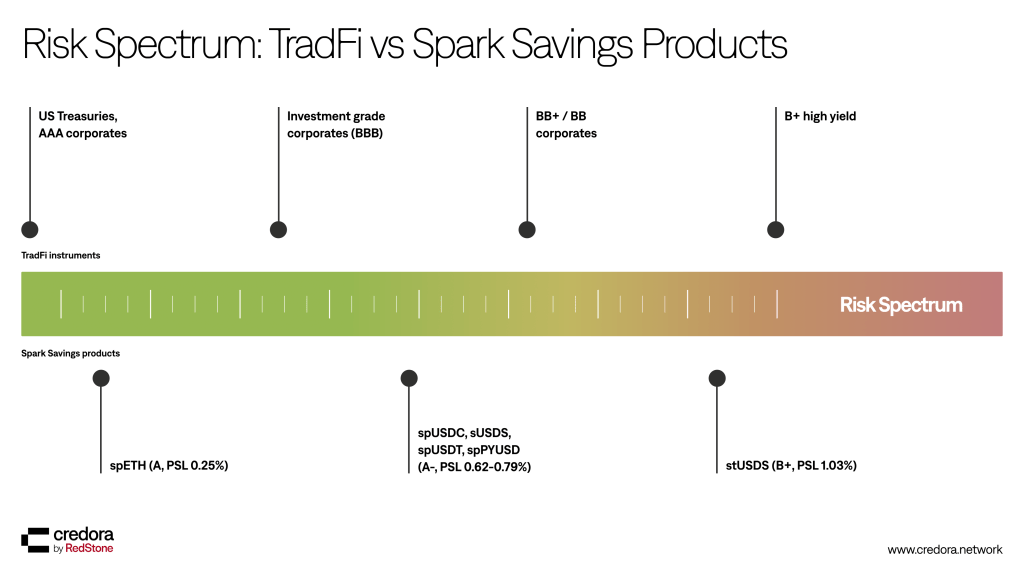
- Six Spark Savings vaults are now rated A+ to B+, with PSL from 0.25% to 1.03%, placing several in investment-grade territory.
- Ratings start from collateral default risk, then apply structural risk modifiers for regulation, reserves, user rights, and governance.
- Ratings are recalculated within 24 hours of any material change in underlying risk factors.
- Full risk reports for each vault are available in Spark Savings, ready for compliance and investment committee review.
Institutional-Grade Risk, Now On-Chain
For decades, institutional capital allocation has rested on a single precondition: before you deploy capital, you need a credible, standardized measure of the risk you are taking on. A pension fund buying BBB-rated corporate bonds is making a measured decision within a known risk framework, one that can be documented, defended, and stress-tested against historical default data. DeFi, despite yields that would be extraordinary in any traditional fixed-income context, never had that framework. Without a probability of default that a compliance officer could trace back to something real, DeFi yields were not an opportunity. They were just noise.
That changed in March 2026, when Spark became one of the first major DeFi protocols to embed independent, institutional-grade risk ratings directly into its user interface. The ratings are produced by Credora, a product by RedStone, and they sit exactly where a capital allocator needs them: at the point of deposit decision, visible, traceable, and grounded in the same credit risk methodology that underpins S&P and Moody’s.
What follows is an explanation of that methodology, what the ratings mean for the six Spark Savings products now carrying a Credora score, and why this moment matters for any institution that has been watching DeFi from a distance.
The Real Reason Institutional Capital Stayed Out of DeFi
When Terra collapsed in May 2022, wiping out approximately $40 billion in value within days, the dominant narrative in traditional finance was simple: DeFi is too risky for serious capital. But this diagnosis missed the actual problem.
Terra’s mechanics were not opaque to anyone who examined them carefully. The algorithmic peg between UST and LUNA created a reflexive dependency that any credit analyst familiar with structured products would have flagged immediately: a system where collateral value was correlated to the very confidence it was supposed to support. The same logic that makes a CDO squared dangerous in a credit crunch made Terra fragile in a sentiment shift. The risk was there. It was just never translated into a number that institutions knew how to use.
Four years later, the pattern repeated. In November 2025, xUSD, a yield-bearing stablecoin issued by Stream Finance, lost its peg after suffering a $93 million loss. Risk had accumulated across leveraged, multi-protocol strategies until it surfaced all at once. Again, the risk was visible in retrospect. Again, there was no standardized framework that would have quantified it before capital was deployed.
This is the structural problem. DeFi’s failures have been caused by risks that were never translated into a language that integrates with how institutions actually manage portfolios. A risk manager does not think in terms of “this looks sketchy” or “this seems fine.” They think in terms of probability of default, loss given default, and how a position’s risk profile correlates with the rest of the book. Without those numbers, there was no framework that let a portfolio manager say to their investment committee: here is the probability that this position generates a significant loss, here is what drives that probability, and here is how it compares to the credit risk we are already carrying.
Credora was built to provide exactly that framework.
How Credora Measures DeFi Risk: A Framework Institutions Already Know
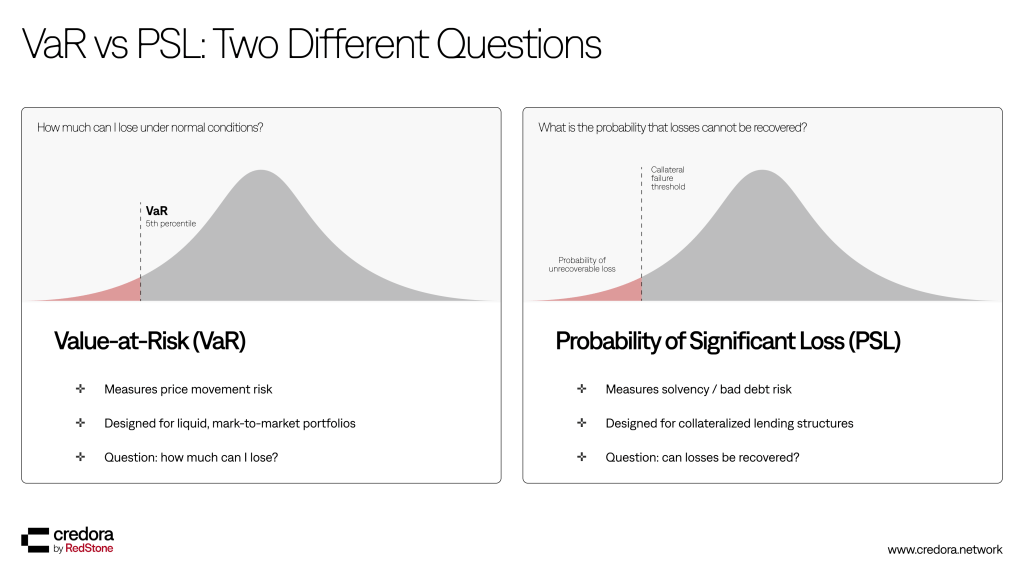
Most risk tools in DeFi focus on volatility: how much can this asset’s price move, and how quickly. Credora measures something different. Its core output is the Probability of Significant Loss (PSL), defined as the annualized likelihood that a protocol or vault experiences bad debt exceeding 1% of principal. PSL is a solvency metric, not a volatility metric, and the distinction matters enormously for institutional purposes.
Value-at-Risk, the standard tool most risk managers use daily, tells you how much you can lose under normal market conditions at a given confidence level. PSL asks a different question: what is the probability that the collateral backing this lending position fails to cover outstanding loans, leaving a residual loss that cannot be recovered? That is the question a credit analyst asks when evaluating a CLO tranche or a covered bond. Credora applies that same analytical lens to DeFi lending markets and vaults.
The methodology employs a bottom-up assessment approach across three hierarchical levels. Collateral assets are rated first, establishing the credit quality of each underlying token. Those asset ratings feed into lending market assessments, which quantify liquidation and bad debt risk for each loan-collateral pair. Market ratings are then aggregated at the savings product level, weighted by current allocation and adjusted for product-specific structural features. This layered structure means that a change in the credit quality of a single collateral asset propagates through the entire framework automatically.
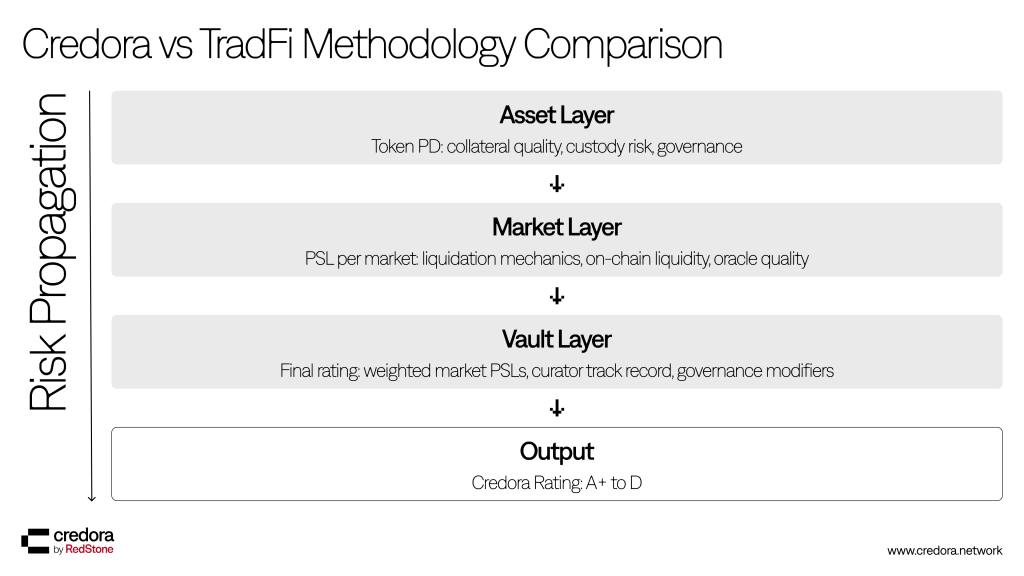
The assessment of USDS illustrates how this hierarchy works in practice. USDS underlies four of the six rated products, so its rating is the central input to the framework. The assessment begins with an Anchor Probability of Default (PD) derived from the credit quality of its collateral portfolio. Risk modifiers are then applied to capture structural and qualitative risks not reflected in the underlying positions alone.
USDS Collateral Analysis (Anchor PD)
Collateral positions are classified into four categories (Stablecoins, Lending Markets, Private Credit, and T-Bills), each assessed using the methodology most appropriate to its structure.
Stablecoins are assessed using the Asset Methodology. Liquidity pool positions within this category are assessed using the Liquidity Pool Methodology, which evaluates smart contract risk, impermanent loss, and the default risk of each underlying asset in the pair. Lending Markets encompass both on-chain positions (SparkLend, Morpho, Aave) and OTC lending positions, assessed using the Lending Markets Methodology. When Spark supplies assets to external markets, the credit risk of the loan asset is incorporated into the assessment. Private Credit and T-Bills are tokenized real-world asset positions held in custody, both assessed using the Asset Methodology.
The Anchor PD is calculated as the union probability of PSLs across all rated collateral positions, combining the composite credit quality of the underlying portfolio with smart contract custody risk assessed via the Smart Contract Sub-Methodology.
USDS Risk Modifiers
Notch-based adjustments are applied to the Anchor PD to capture risks not reflected in the collateral assessment itself. These modifiers evaluate the regulatory standing of the issuer, the transparency and governance of reserve management, the legal rights of token holders, the historical stability of the peg, the relative market capitalization of the stablecoin, and the structure of protocol governance and upgrade mechanisms. The full modifier framework is detailed in the Asset Methodology.
Savings Product Ratings
The six Spark Savings products are assessed across three distinct risk exposures. The four stablecoin vaults (USDS, USDC, USDT, PYUSD) share common exposure to USDS collateral backing, with minor rating differentiation driven by idle liquidity buffer sizes and the exclusion of entry-stablecoin loan asset default risk from each product’s assessment. spETH derives its credit risk from SparkLend’s ETH lending market, with the rating measuring incremental risk relative to holding ETH directly rather than ETH price depreciation. stUSDS carries the highest incremental risk, reflecting its exposure to an isolated SKY/USDS lending market where borrower position distribution, collateral volatility, and limited DEX liquidity depth are the primary drivers of the simulation output.
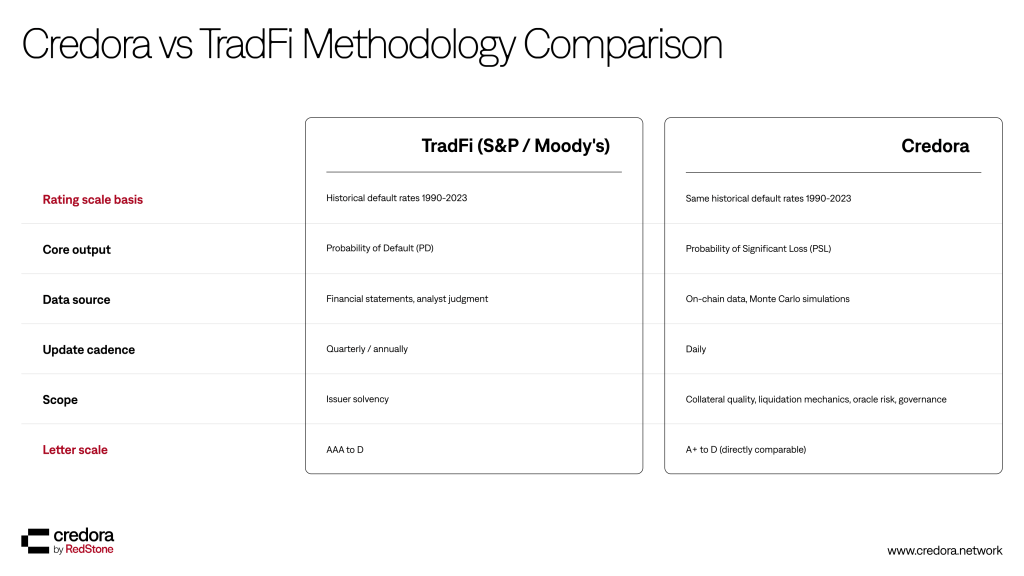
The final output is a rating from A+ to D with an associated PSL range that maps onto existing credit frameworks. What distinguishes it from a traditional agency rating is cadence: while S&P reviews ratings quarterly or annually, Credora’s ratings update in real-time when material changes in collateral composition or market conditions warrant it. They function as an early warning signal, not a post-mortem label.
Spark Savings: What the Ratings Actually Say
Abstract methodology only goes so far. The more useful exercise for an institution evaluating DeFi exposure is to walk through a concrete example and see exactly how a rating is produced. Spark Savings currently offers six rated products, and the range of outcomes across them illustrates both how the methodology works in practice and why not all DeFi yield is created equal.
The six products and their Credora ratings at launch are as follows, noting that ratings are dynamic and will update as collateral composition and market conditions change:

Four of the six products share the same fundamental risk driver: the credit quality of USDS, the stablecoin issued by Sky Protocol. Understanding the USDS rating is, therefore, the key to understanding most of the Spark Savings risk profile.
Rating USDS: from collateral to final PD
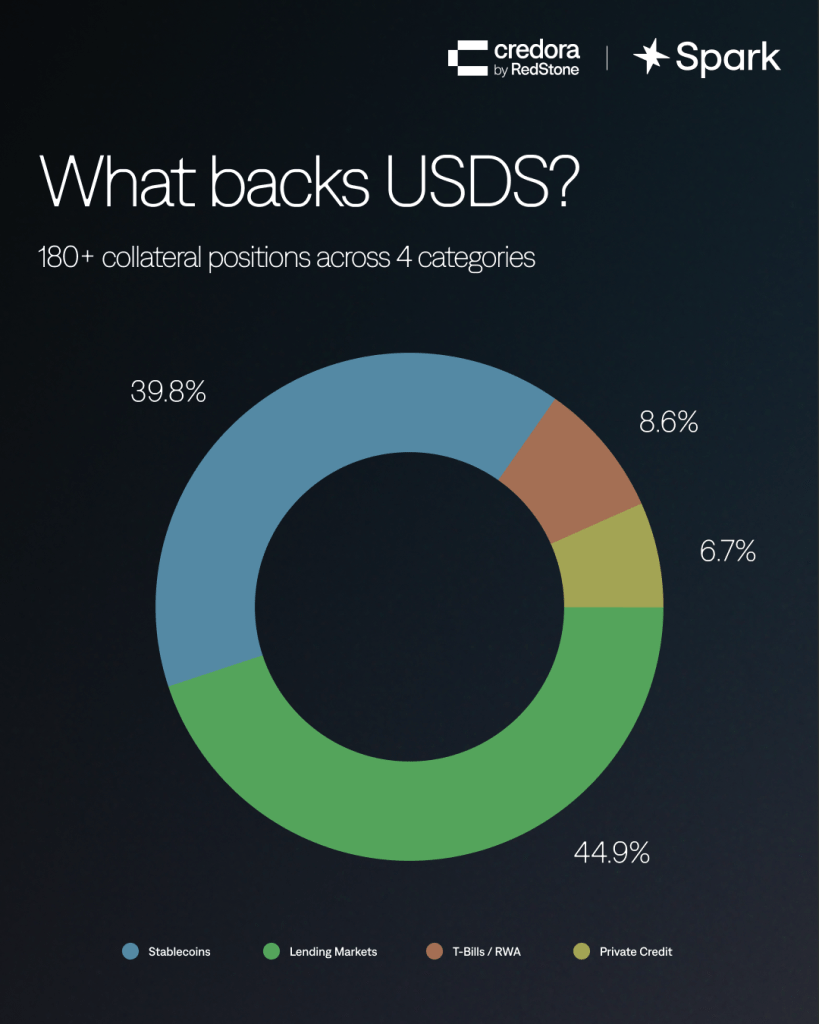
USDS is not backed by a single asset. Its collateral spans over 180 positions across four categories: stablecoins (44.9%), lending markets including SparkLend and Morpho (39.8%), private credit (8.6%), and tokenized T-bills (6.7%). Each category is rated using a different methodology. Stablecoins are assessed on reserve quality, peg track record, and governance. Lending market positions go through the full market-layer simulation described in the previous section. Private credit and T-bills are evaluated on asset quality and custody risk.
The aggregation of these inputs produces an Anchor PD of 0.50% for USDS, which corresponds to a raw rating in the A range. From there, a series of qualitative modifiers shift the final figure:
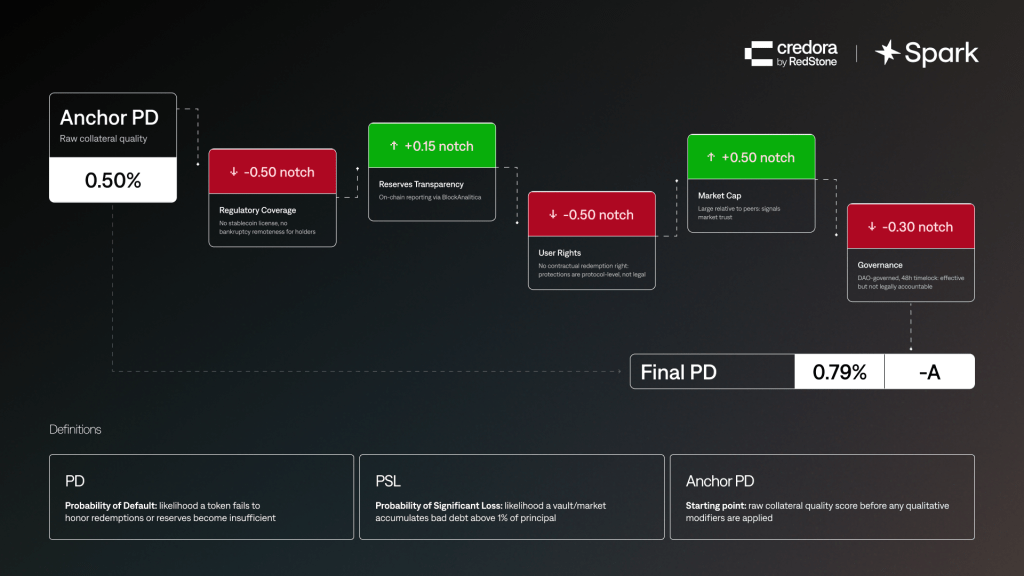
The net effect of these adjustments moves the Final PD to 0.79%, placing USDS at A-. For the four Spark products backed primarily by USDS, this rating forms the floor. Minor differences in their individual PSL figures reflect differences in how each product is structured on top of the USDS base, but the dominant risk driver is the same across all four.

ETH vault: a different risk profile entirely
ETH vault earns yield through SparkLend’s ETH lending market rather than through USDS collateral exposure. Its risk profile is correspondingly different: the primary driver is the behavior of ETH as collateral in a lending market, specifically the probability that ETH price movements trigger liquidations that cannot be executed cleanly given available liquidity. With conservative loan-to-value parameters, strong on-chain liquidity for ETH, and a well-established liquidator ecosystem, the simulation produces a PSL of 0.25%, earning spETH an A rating. For an institution with existing views on ETH as an asset, this product offers a way to earn yield on that exposure within a quantified risk framework.
USDS vault: why the B+ rating exists
USDS is the outlier in the Spark Savings lineup, and it is worth examining carefully because it illustrates exactly the kind of risk differentiation that makes ratings useful. USDS vault lends USDS to borrowers using SKY tokens as collateral through an isolated lending market. The elevated PSL of 1.03% and the resulting B+ rating reflect a specific structural feature: at the time of assessment, the market carried approximately $125 million in outstanding debt against roughly $600,000 in available on-chain liquidity for SKY. That liquidity gap means that in a stressed scenario where SKY collateral needs to be liquidated at scale, the market’s ability to absorb that liquidation without generating bad debt is materially constrained.
The B+ rating does not mean USDS vault is a poor product. It means the yield it offers reflects a genuinely higher risk profile than its A- A-rated counterparts, and that an institution allocating to it should size the position accordingly. This is precisely the kind of differentiation that was impossible to make in DeFi before standardized ratings existed.
What the Ratings Mean for Portfolio Construction
For an institution that has followed the methodology this far, the practical question is straightforward: how does a Credora-rated DeFi product fit into a portfolio relative to instruments the institution already holds?
The translation starts with spreads. An A rating from Credora maps to BBB and BBB- on the S&P scale, qualifying as investment-grade. An A- maps to BB+ and BB, just below that threshold. As of early 2026, BB-rated US corporate bonds are yielding in the 6% to 7% range. The A- rated Spark Savings products are yielding in a comparable range, but the nature of the underlying risk is meaningfully different. A BB corporate bond concentrates risk in a single issuer. The A- Spark products carry exposure distributed across 180+ collateral positions in four asset categories, each rated independently. For a portfolio manager thinking about correlation, the risk factors driving a potential loss in sUSDS are largely uncorrelated with those that would stress a corporate bond portfolio. A credit shock hitting a single corporate issuer does not move DeFi collateral risk, and vice versa. That asymmetry gives the position genuine diversification value beyond its nominal yield, and it is the kind of argument that holds up in front of an investment committee precisely because it is grounded in comparable risk metrics rather than a qualitative claim about a new asset class.
The broader point for portfolio construction is this: traditional fixed income mandates are built around rating-based guidelines. Investment committees set floors, risk teams monitor drift, and position sizing reflects rating-implied default probabilities. Credora’s ratings make it possible to apply exactly the same logic to DeFi allocations. A family office with a mandate to stay above BB- equivalent credit quality can now screen DeFi products against that mandate with the same rigor it applies to its corporate bond book. That does not require treating DeFi as a separate asset class with its own bespoke framework. It requires recognizing that the ratings infrastructure to evaluate it on familiar terms now exists.
Spark’s Strategic Bet and Why It Matters Beyond the Integration
DeFi protocols have historically competed on yield. That competition produced genuine innovation but also a systematic under-investment in the transparency infrastructure that institutional capital requires before it can participate at scale. Risk disclosure was treated as friction rather than as a feature that could attract a qualitatively different class of capital.
Spark’s integration inverts that logic. By embedding independent, methodology-backed ratings at the point of deposit, Spark is accepting external scrutiny of its own products as a differentiator rather than a threat. The ratings are produced by an independent third party and displayed within Spark’s interface, which means the commitment to transparency is verifiable and ongoing, not a one-time marketing claim.

The historical parallel worth drawing is not from DeFi. When early corporate issuers sought ratings from Moody’s in the early twentieth century, the immediate motivation was access to capital from investors who required standardized risk assessment before they could allocate. The issuers that moved first did not just gain a broader investor base. They helped establish the expectation that any serious issuer would carry a rating, which gradually made the absence of one a signal in itself.
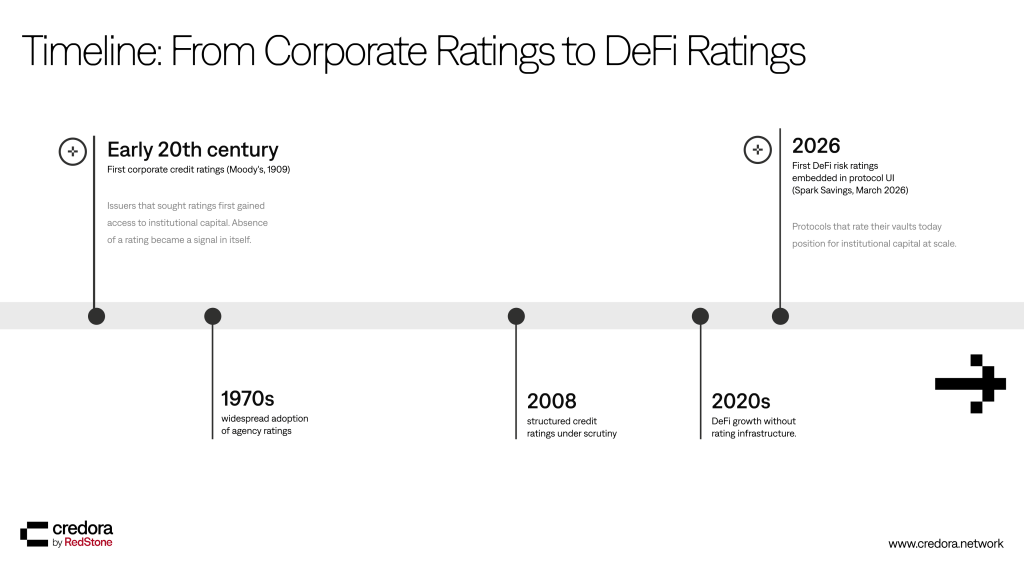
The protocols that establish rated products today are positioning themselves on the right side of a similar transition. For institutions, the practical implication is this: the question is not only whether a specific Spark Savings product meets a risk threshold today, but whether the protocol’s commitment to ongoing transparency creates the conditions for a durable institutional relationship over time. Spark, with Credora’s ratings embedded in its interface, has those foundations in place.
Where to Start
The full picture is in the report. Credora’s Spark Savings Risk Assessment covers every rated product in detail: collateral composition, simulation outputs, modifier logic, and the methodology behind each rating. It is designed to be the document an institution puts in front of a compliance team or investment committee, written in the language of credit risk rather than DeFi native terminology. The report is available directly within the Spark Savings interface under the Risk Assessment tab, and Credora’s complete rating documentation is publicly available here: LINK
Credibility Precedes Capital. The Time to Build It Is Now.
DeFi does not need more yield. It needs the infrastructure that allows serious capital to evaluate yield on terms it already understands. Credit ratings, probability of default, loss given default, methodology that can be audited and defended: these are not foreign concepts being imported into DeFi from a more conservative world. They are the preconditions for any asset class to attract institutional participation at scale.
What Credora has built, and what Spark has chosen to make visible at the point of deposit, is that infrastructure. The ratings on Spark Savings are not a marketing layer. They are a quantitative output of a methodology grounded in the same historical default data that anchors S&P and Moody’s, applied to the specific mechanics of on-chain lending markets, and updated at a cadence that reflects how quickly DeFi risk actually evolves.
For institutions that have been watching DeFi from a distance, waiting for a framework that speaks their language, that framework now exists. The question is no longer whether DeFi yields can be evaluated with institutional rigor. The question is which protocols will have established the track record of transparent, rated, auditable products by the time the broader allocation shift arrives. The ones that moved first will have the answer.
About Credora: Credora provides independent, data-driven risk ratings for on-chain finance. By standardizing risk measurement across assets, lending markets, and vault strategies, Credora enables transparent, resilient capital allocation. Through quantitative modeling, stress testing, liquidity analysis, and governance assessment, Credora converts complex protocol mechanics into comparable risk signals, supporting the sustainable growth and institutional adoption of on-chain markets.
About Spark: Spark operates as a two-sided capital allocator. On the ecosystem side, it borrows from Sky’s stablecoin reserves and deploys capital across DeFi, CeFi, and RWAs. On the user side, Spark packages that yield into accessible products like sUSDS and sUSDC, giving users seamless access to onchain, programmable income that is diversified, fee-free, and composable.