
Lista DAO Vault Risk Rating
ListaDAO’s three curated vaults on BNB Chain carry independent risk ratings from Credora. The BNB Vault is rated A at a Probability of Significant Loss (PSL) of 0.29% annually. The USDT Vault is B+ at 1.04%. The USD1 Vault is A- at 0.68%.
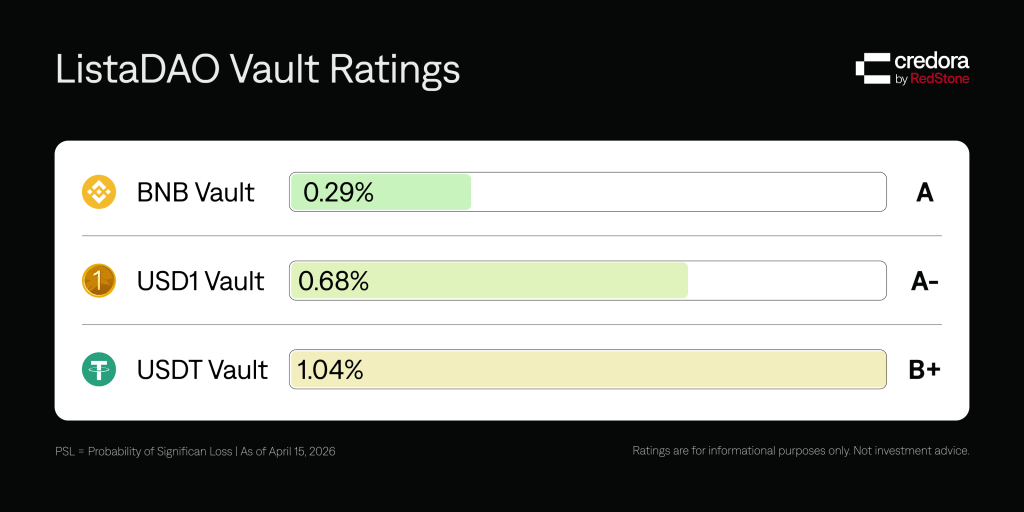
PSL is Credora’s core risk output: the annualized probability that a depositor incurs a loss exceeding a defined significance threshold under the current portfolio configuration.
All three vaults share a protocol infrastructure. The BNB Vault and the USD1 Vault sit 2.4x apart in PSL terms. The difference comes from collateral and curation.
Protocol Architecture
Lista Lending, also known as Moolah, is a peer-to-peer lending protocol launched on BNB Chain in April 2025. It operates on a dual-layer architecture: at the vault level, supplier liquidity is pooled and allocated across lending markets by a designated curator; at the market level, each pool pairs one collateral asset against one loan asset with parameters set immutably at deployment. Markets are isolated. Risk does not spill between them.
ListaDAO introduces two structural features not common in standard lending protocols.
Smart Collateral, offered through Lista’s Smart Lending product, allows collateral deposited into a lending market to simultaneously remain deployed in a DEX liquidity pool. Borrowers earn trading fees on otherwise dormant collateral. From a rating perspective, these LP positions are assessed under Credora’s Liquidity Pools Methodology: the LP PD equals the joint probability of the constituent assets defaulting, compounded with the DEX protocol’s own PD. Where the two pooled assets share overlapping risk, as in the slisBNB & BNB pool where both the LST and the underlying BNB chain exposure originate from ListaDAO, the overlapping component is excluded to avoid double-counting.
Fixed Markets allow borrowers to lock in a rate for 7, 14, or 30-day terms. Expired fixed-term loans convert automatically to flexible rate positions. The two products share identical structural risk characteristics for rating purposes.
Curation Structure
Vault curation on Lista Lending determines which markets receive capital and in what proportion. Curator quality directly affects a vault’s rating through the curator notch component.
On April 27, 2026, ListaDAO announced Gauntlet as an official vault curator on Lista Lending. Gauntlet is one of DeFi’s established risk management operators, with $1.5B+ in vault TVL curated and $35B+ under risk management mandate. Four vaults are now live under the partnership.
The BNB and USD1 vaults are co-curated by ListaDAO and Gauntlet. Under this structure, Gauntlet owns day-to-day operations and active strategy optimization. ListaDAO retains protocol-level governance and oversight. The USDT Vault assessed in this report is the Gauntlet USDT Vault, curated solely by Gauntlet as the primary Tier 1 curator.
For rating purposes, a curator notch of +0.25 applies across all three vaults: BNB and USD1 as co-curated vaults (internal and external Tier 1), and the USDT Vault as a solely Tier 1-curated product. The governance notch of -0.375 applies uniformly. Net notch adjustment: -0.125.
Methodology

The rating process is bottom-up: collateral asset Probabilities of Default (PD) feed market-level simulations, which aggregate into vault-level PSL. Credora full methodology
At the market level, Credora runs thousands of daily return scenarios over a 30-day horizon on each collateral/loan pair. Three dynamics are modeled: normal returns via historical volatility; tail events fitted using a Generalized Pareto Distribution (GPD) calibrated to extreme historical price movements; and collateral default scenarios constructed from asset-specific PD and loss-given-default distributions. A logistic regression rebalancing model adjusts for borrower behavior as positions approach the LLTV threshold.
Price paths that breach LLTV feed a liquidation simulation. Available DEX liquidity is applied against the collateral position in sequential steps, accounting for price impact at each step. Each partial liquidation reduces the outstanding loan balance before the next step runs. The simulation ranks multiple configurations and averages them to produce the market-level PSL.
At the vault level, the Anchor PSL is the allocation-weighted average of market PSLs. Markets with larger capital allocations contribute proportionally more to this figure. Curator and governance notch adjustments are applied on top to produce the Final Vault PSL.
Collateral Universe
22 collateral assets and 10 proxy positions are rated across the three vaults. Asset PDs range from 0.01% to 6.22%.
At the low end: ETH, wBNB, USDC, ASTER, ANRK, all A+ rated with near-zero PD. Centralized custody assets (BTCB, wBETH) and liquid staking tokens (slisBNB, slisBNBx) cluster in the A range at 0.36–0.37%. The highest-risk collateral in the set is USDF and asUSDF at 6.22% PD, C+ rated, driven by low issuer transparency.
The 10 proxy positions span Pendle PT tokens and Smart Collateral LP tokens. For PT tokens, Credora applies a PD uplift equal to the Pendle protocol’s own PD on top of the underlying asset’s PD. [External link: Pendle protocol documentation] The uplift is most pronounced on active strategy stablecoins: PT-srUSDe reaches 3.78% (vs. sUSDe at 2.83%), PT-USDe and PT-sUSDe reach 3.08%. PT-clisBNB, built on slisBNB, reaches 0.63%. The more complex the underlying exposure, the more visible the Pendle layer becomes in the final PD.
On the LP side, pool composition is the primary driver. The USDC & USDT-SmartLP and the slisBNB & BNB-SmartLP both achieve A- ratings at 0.57% and 0.37% PD respectively, given their high-quality constituents. BTCB & solvBTC-SmartLP, U & USDT-SmartLP, and SolvBTC.DLP cluster in B+ territory at 0.86–1.40%.
BNB Vault
Anchor PSL: 0.27% | Final PSL: 0.29% | Rating: A
The BNB Vault is concentrated and homogeneous. slisBNB markets, fixed and flexible combined, hold 74.93% of vault weight at a 0.27% PSL. USDT markets at 11.12% and BTCB at 7.22% provide the remaining material allocations, all carrying A ratings. All active markets rate A.
The vault is co-curated by ListaDAO and Gauntlet. The difference between the BNB Vault’s PSL and its peers is structural: BNB Chain borrowing demand flows through slisBNB, ListaDAO’s native LST, which concentrates risk in a single high-quality collateral family. The residual PSL above pure slisBNB exposure reflects ListaDAO protocol-level risk applied across all markets in the vault.
USDT Vault
Anchor PSL: 0.97% | Final PSL: 1.04% | Rating: B+
BTCB holds the largest allocation in this vault at 35.23%, contributing a 0.26% PSL. It is the largest position by size, not the primary risk driver.
sUSDe is the primary risk driver. The fixed sUSDe position carries 32.07% weight at a 2.31% PSL. A flexible sUSDe position adds another 1.32% weight, bringing combined sUSDe exposure to approximately 33.4%. All remaining positions are rated A, with slisBNB markets at 14.70% and 5.89% providing the next largest low-risk allocations.
The B+ vault rating is a direct function of sUSDe concentration. Approximately a third of the vault’s capital sits in one market at a 2.31% PSL. The path to rating improvement runs through reducing that exposure.
USD1 Vault
Anchor PSL: 0.63% | Final PSL: 0.68% | Rating: A-
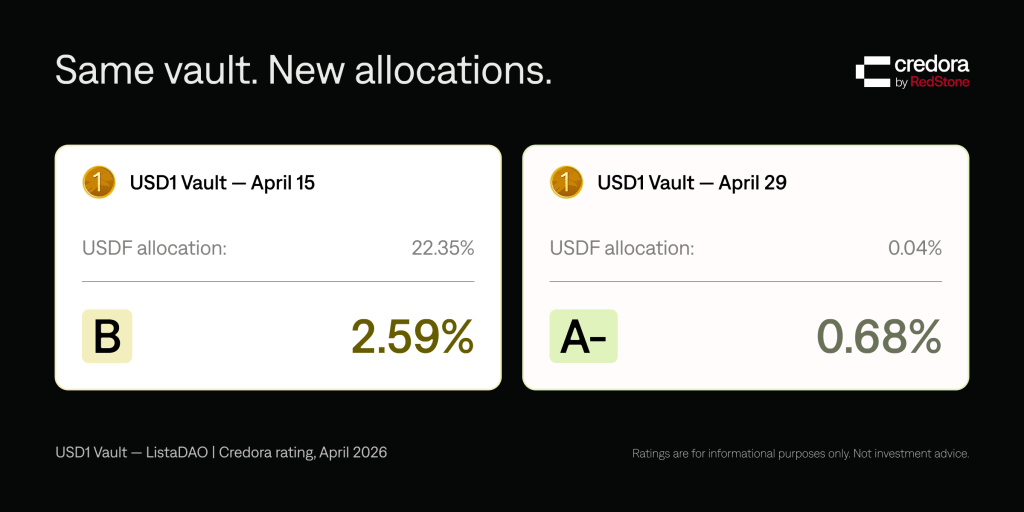
The USD1 Vault shows the most significant change across the three vaults. At the time of Credora’s initial data collection on April 15, 2026, USDF held 22.35% of vault weight with a 5.78% PSL (C+), making it the single largest individual risk factor across all three vaults. A second high-risk position, sUSDe, held 15.08% weight at a 2.40% PSL. Together, these two positions sat alongside USDC & USDT-SmartLP at 22.61% weight and 0.27% PSL — two positions at nearly identical allocation sizes, 21x apart in risk.
USDF now holds 0.04% of vault weight. The position has been reduced by more than 99%.
Two other changes account for the remainder of the improvement. BTCB positions totaling approximately 27.6% of vault weight have been added, both carrying A ratings at 0.26% PSL. The USDC & USDT-SmartLP position has grown from 22.61% to 36.09%.
sUSDe remains in the vault at approximately 15.2% combined weight with a 2.39% PSL. It is now the vault’s dominant risk factor. The vault-level PSL is materially lower not because sUSDe was reduced, but because USDF — carrying a PD more than twice that of sUSDe — has been removed.
A small asUSDF position (0.68%, 4.62% PD, B-) is present in the current composition. At current allocation, its contribution to the anchor PSL is limited.
The anchor PSL has compressed from 2.06% to 0.63%. The final vault PSL is 0.68%, corresponding to an A- rating.
The allocation change followed Gauntlet’s entry as co-curator on April 27. Gauntlet’s day-to-day operations mandate covers market allocation and strategy optimization. The reduction in USDF exposure and the addition of BTCB positions are consistent with an active risk management approach applied to a vault that previously concentrated exposure in unaudited collateral.
Governance Adjustment
A governance notch of -0.375 is applied uniformly across all three vaults. ListaDAO operates with a 24-hour timelock and no guardian role. The notch reflects the absence of a second protective layer capable of blocking adverse parameter changes within the timelock window before depositors can act.
The curator notch is +0.25 across all three vaults, reflecting Internal tier curation. ListaDAO and Gauntlet co-curating the BNB and USD1 vaults, and ListaDAO on the USDT Vault, qualify under this classification.
Net notch adjustment: -0.125. The absolute impact on the final PSL ranges from approximately 0.02 to 0.05 percentage points depending on the anchor.
What Moves the Ratings
Ratings are dynamic. They update within 24 hours of any material exposure change. The primary variables: collateral allocation decisions by the curator, changes in individual asset PDs, and changes to market-level parameters (LLTV, oracle type, available DEX liquidity).
For the USDT Vault, the path to further improvement runs through sUSDe concentration. Reducing the single-market exposure below 20% and shifting weight to A-rated collateral compresses PSL directly.
For the BNB Vault, the primary sensitivity is the slisBNB PD itself, which moves with underlying LST and BNB chain risk.
For the USD1 Vault, the current composition reflects a materially rationalized collateral set. The primary remaining variable is the curator’s ongoing allocation decisions.
Summary
Three ListaDAO vaults on BNB Chain carry Final PSL scores of 0.29%, 1.04%, and 0.68%, corresponding to ratings of A, B+, and A-. The spread is driven by collateral quality and allocation decisions, not protocol architecture. In the USDT Vault, sUSDe at approximately 31% of weight is the primary risk driver. In the USD1 Vault, the collateral set has been rationalized since the April 15 data collection: USDF and sUSDe allocations have been removed, and USDC & USDT-SmartLP now holds the dominant position at 36.09% weight and 0.27% PSL. A governance notch of -0.375 applies uniformly, reflecting the 24-hour timelock configuration and the absence of a guardian role. The curator notch of +0.25 applies across all three vaults, reflecting ListaDAO and Gauntlet’s Internal tier curation.
FAQ
What is Credora’s rating for ListaDAO vaults?
Credora rates three ListaDAO vaults on BNB Chain: the BNB Vault carries an A rating at 0.29% PSL annually, the USDT Vault a B+ at 1.04%, and the USD1 Vault an A- at 0.68%. Ratings are dynamic and update within 24 hours of material changes to collateral composition or market parameters.
What is the biggest risk driver in the ListaDAO USDT Vault?
The primary risk driver is sUSDe, an active-strategy stablecoin holding approximately 31% of vault weight at a 2.32% market PSL. All other positions in the vault are rated A. The B+ vault rating is a direct function of this single concentrated position.
Why did the USD1 Vault rating improve from B to A-?
The primary driver is the reduction of USDF from 22.35% to 0.04% of vault weight. USDF carried a 5.78% PSL (C+, 6.22% Probability of Default) and was the single largest individual risk factor across all three vaults at the time of the April 15 data collection. Its removal, combined with the addition of BTCB positions (~27.6% weight, A-rated) and growth in USDC & USDT-SmartLP (from 22.61% to 36.09%), compressed the anchor PSL from 2.06% to 0.63%. sUSDe remains in the vault at approximately 15.2% weight and is now the dominant risk factor. The final vault PSL moved from 2.59% to 0.68%. Gauntlet joined as co-curator on April 27, 2026, with a mandate covering day-to-day operations and strategy optimization.
How does ListaDAO’s governance structure affect its vault ratings?
ListaDAO operates with a 24-hour timelock and no guardian role on its vaults. Credora applies a governance notch of -0.375 to all three vaults, reflecting the absence of a second protective mechanism that would allow depositors more time to respond to adverse parameter changes before they take effect. A curator notch of +0.25 partially offsets this adjustment, resulting in a net notch of -0.125.
Full report and live API data available at: https://reports.credora.network/
Ratings reflect current vault composition as monitored by Credora. Initial data collection: April 15, 2026. Credora monitors collateral composition on a continuous basis and updates ratings within 24 hours of material changes.