
Morpho Midnight risk: how fixed-term lending changes credit analysis
Morpho Midnight brings fixed-rate, fixed-term, fixed-maturity lending to Morpho, alongside the variable-rate markets of Morpho Blue. The mechanics depart substantially from Blue. The credit risk drivers hold. This article sets out where Morpho Midnight risk diverges from the dynamic markets, where it stays constant, and how Credora’s methodology applies to the new structure.
Credora expresses credit risk as a Probability of Significant Loss (PSL): the annualized probability that a position loses more than 5% of principal. The question here is which inputs to that number change when a market has a maturity date and more than one collateral.
What changes structurally in Morpho Midnight markets

Midnight markets are isolated, immutable, and permissionlessly created, the same design DNA as Blue. Three properties depart from the variable-rate model.
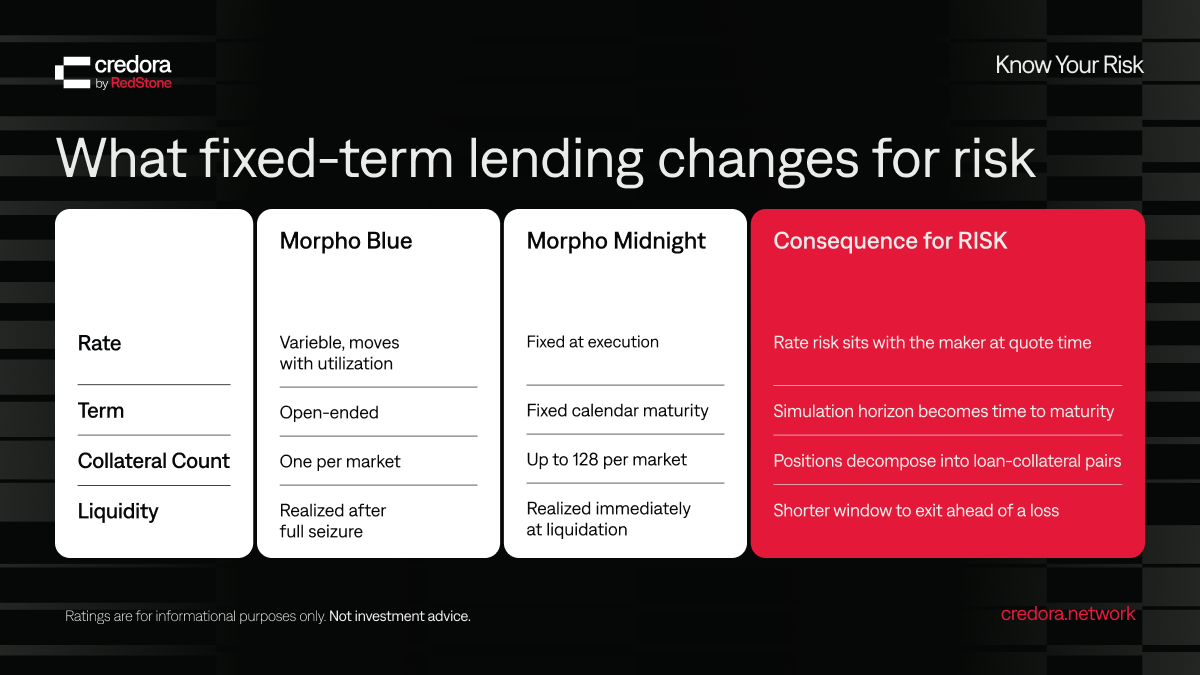
The rate is fixed at execution. It is implied by the discount at which credit and debt units trade: for a traded unit price P, the simple rate over the remaining term is r = 1/P – 1. Interest-rate risk therefore sits with the maker at quote time. On Blue, the position carries it for as long as it stays open, because the rate moves with utilization.
Maturity is a fixed calendar date, set independently of when a position opens. Positions created at different moments with the same maturity are fungible and sit in the same market. In practice, the market is the maturity date.
There is no shared liquidity pool. Lending is organized as direct lender-to-borrower positions, priced through executable offers. Because the resulting claims are tradable, those pairings need not hold for the life of the loan. Liquidity is sourced at the moment an offer is filled, and it sits uncommitted until then.
A Midnight market therefore decomposes into discrete term positions, each priced at a discount and each settling on a known date. Exposure is measured over a defined term with a known endpoint, and that is the property the assessment turns on. Morpho’s whitepaper states that its terminology describes mechanics functionally and characterizes no regulated instrument.
Multi-collateral exposure and the absence of rehypothecation
The change with the largest effect on Morpho Midnight risk is that a single position can be backed by more than one collateral. A Midnight market permits up to 128 collaterals, and a borrower can hold at most 16 activated at once. Each carries its own price feed and its own Liquidation Loan-to-Value (LLTV), so maximum debt is the sum of each collateral’s balance multiplied by its price and its LLTV.
The likelihood of bad debt now depends on the price, quality, and correlated behavior of several assets rather than one.
Multi-collateral lending is common in DeFi. What separates Midnight from comparable designs is the absence of rehypothecation, the reuse of posted collateral as lendable assets backing other loans. Pooled designs such as Aave, and cluster-based designs such as Euler, redeploy collateral in exactly this way. On Midnight, collateral sits in isolation and backs only the positions it is assigned to. That removes one transmission channel through which a single asset failure propagates across a protocol.
One caveat for anyone assessing collateral composition: the composition is not static. Borrowers in multi-collateral markets can rotate which collaterals are activated, subject to a health check on withdrawal. The set of price feeds a lender is exposed to at origination is not necessarily the set they are exposed to at maturity.
The risk factors that stay constant
The core exposures a lender takes on in a Midnight market are the same four that apply to the dynamic markets.
- Market risk: sudden price movements that trigger cascading liquidations or prevent liquidations from executing at expected levels.
- Collateral default risk: a collateral asset losing value through depeg or impairment, or falling to zero.
- Oracle failure risk: mispricing or stale pricing from a compromised or degraded feed. With one feed per collateral, the surface widens in proportion to the number of activated collaterals.
- Platform and smart contract risk: Midnight is a new codebase, comparatively simple, independently audited, with the source public.
These four drive loss in the same way they drive it on Blue, which is why the framework Credora applies to the dynamic markets carries over intact.
How Credora assesses Morpho Midnight risk
Credora’s existing aggregation stack maps onto Midnight through the same virtual market primitive used for the dynamic markets. The assessment runs in four steps.
First, decompose the position. Each position is broken into individual loan-collateral pairs. A borrower with four activated collaterals against one loan asset produces four pairs, each with its own price series and its own LLTV.
Second, build per-pair LTV tranches. Allocations are attributed across pairs so exposure can be tranched by loan-to-value, one level below the aggregate position.
Third, classify each pair’s price feed. Feed methodology, update mechanics, and failure modes are assessed per collateral, because a market’s weakest feed sets a floor on the reliability of the whole configuration.
Fourth, simulate to the loss threshold. Each pair is assessed for the likelihood that collateral price movement or default drives an otherwise healthy position into bad debt. That output is what a PSL expresses.
Two model parameters change for fixed-term markets. The simulation horizon becomes time to maturity rather than a fixed 30-day window, because the position’s terminal date is known at origination. And the liquidity discount is heavier, because offer-based liquidity is sourced at fill and sits uncommitted until then. Exit before maturity is possible by trading the claim, and the price of that exit is a function of what the offer book will bear at the time.
How bad debt is socialized
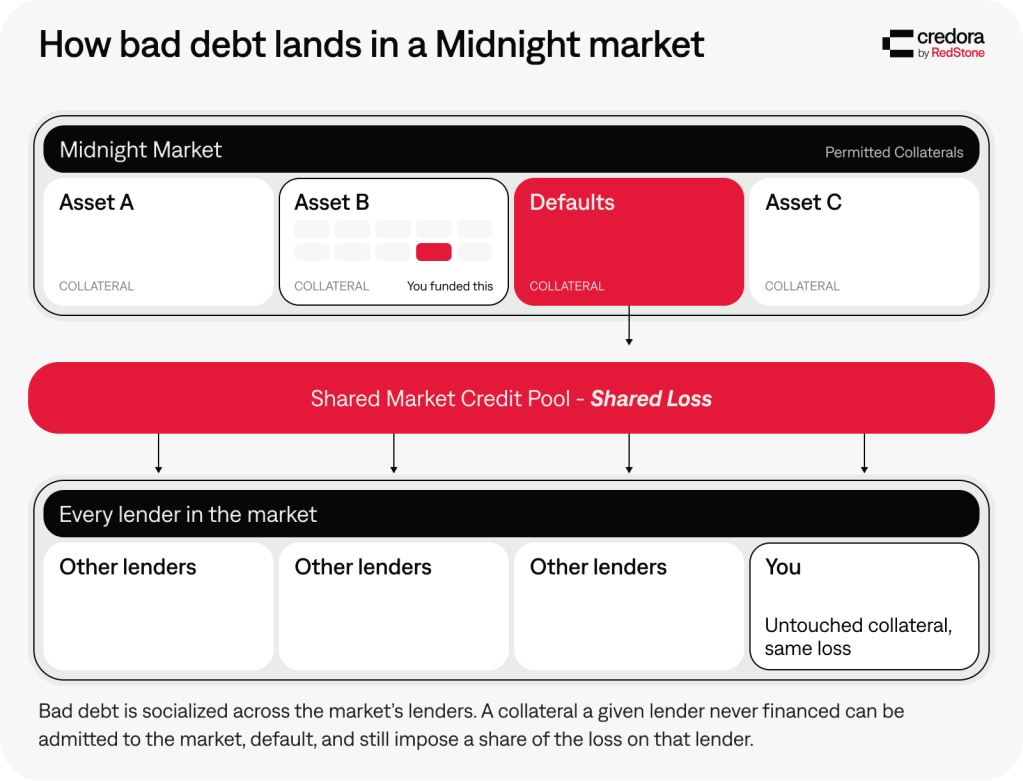
Bad debt in a Midnight market is socialized across that market’s lenders. A lender is exposed to every position in the market, and therefore to every collateral the market permits.
A collateral a given lender never financed can be admitted to the market, default, and still impose a share of the loss on that lender.
That makes market configuration a first-order input to Morpho Midnight risk. The permitted collateral set, the LLTV assigned to each, and the feed behind each one define the loss distribution for everyone in the market. Assessing the loan you funded is insufficient. The unit of analysis is the market.
Two further mechanics shape how the loss lands. Bad debt is realized immediately at liquidation rather than after collateral is fully seized, which shortens the window in which better-informed lenders can exit ahead of a loss. And after maturity, any position with outstanding debt becomes liquidatable regardless of health, through a Dutch auction that raises the liquidation incentive over a 60-minute window. Maturity introduces a liquidation path with no equivalent in the perpetual markets.
Key takeaway
Rate and term move out of the position and into the quote. Maturity replaces the rolling horizon. Collateral count moves from one to as many as 16 activated per borrower, and with it the number of price feeds that have to hold. What a lender is underwriting is therefore a portfolio of loan-collateral pairs with a known terminal date, sharing a loss pool with every other position in the market. The methodology carries over from the dynamic markets. Each market’s configuration is what determines the number it produces.
Frequently asked questions
How does fixed-term lending change DeFi credit risk modeling?
Fixed maturity sets the simulation horizon. The model runs to the market’s terminal date, which is known at origination, and the loss distribution is assessed over that defined term. A fixed rate moves interest-rate variability out of the position and onto the maker at quote time. The underlying loss drivers stay the same: collateral price movement, collateral impairment, feed reliability, and contract risk.
What are the main risks in multi-collateral lending markets?
Exposure scales with the number of activated collaterals, because each carries its own price feed and its own LLTV. Correlated drawdown across collaterals is the primary concern, since assets that fall together remove the diversification the structure appears to offer. Feed reliability is the second, as the number of feeds that must hold rises with the collateral count. Collateral composition can also change during the life of a position, so the exposure set at origination may differ from the exposure set at maturity.
Why does bad debt in an isolated lending market affect lenders who did not fund the defaulting position?
Bad debt is socialized across all lenders in the market. Isolation operates at the market boundary, one level above the individual position. A lender’s loss distribution is therefore determined by every collateral the market permits and every position it contains, which makes the market’s configuration the correct unit of analysis.
Disclaimer
This document is provided for informational purposes only and does not constitute investment, legal, or financial advice. It describes how Credora’s methodology applies to a market structure and does not assign a rating to any Morpho Midnight market. Protocol mechanics described here reflect the Morpho Midnight whitepaper (Morpho Association, May 2026) and the public codebase as of July 2026, and may change.
Credora’s methodology is documented at credora.network/methodology. Live ratings across rated vaults and markets are available in the Credora app.