

Risk as infrastructure: how Credora rates tranched markets
Introduction
Risk ratings in DeFi have always been external. A protocol launches, a risk tool evaluates it, a rating appears on a dashboard. The protocol operates independently of that rating. The rating is something you consult before you enter a position, not something the market itself is built around.
Lotus is designed differently. Credora’s tranche-level ratings are not a layer placed on top of the protocol after the fact. They are part of how the market is structured from day one: informing tranche architecture, feeding allocation logic, and providing the measurable risk language that vault managers and lenders need to operate with precision. The rating is not a decoration. It is infrastructure.
This changes what a risk rating is for. In a market built around Credora’s methodology, a PSL (Probability of Significant Loss) at each tranche is not a reference number you check before depositing. It is a live signal that remains relevant for the duration of your exposure, comparable across every point on the risk curve, and grounded in the same simulation framework that institutional credit markets use to quantify default probability.
To understand why that matters, you need to understand what Lotus is actually building, and why pricing risk across a continuous, tranched market is a fundamentally different problem than pricing risk in an isolated pool.
What is a tranche, and why does it change everything
Most lending protocols give every participant in a market the same risk profile. Supply USDC to an Aave pool or a Morpho vault and your exposure is defined by one set of parameters: the liquidation threshold, the collateral type, the oracle. Everyone in that pool shares the same fate. That simplicity has a cost. It forces the market to converge on parameters that work for the average participant, rather than letting each lender choose the risk they are actually willing to take.
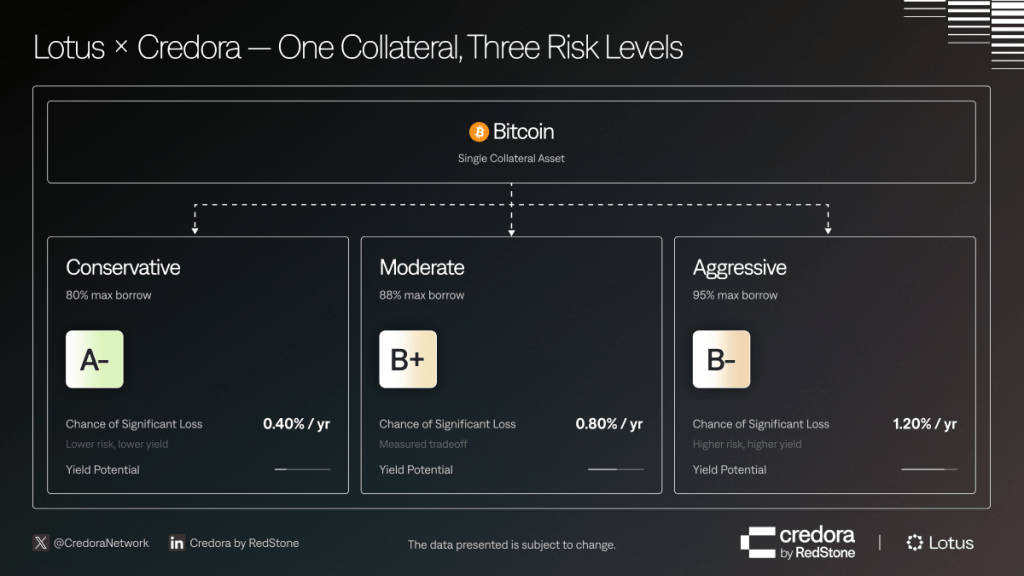
Lotus is built on a different premise. There is one market per asset pair, not many separate pools competing for the same liquidity. Within that single market, lenders and borrowers choose where on the risk curve they want to operate. If you want to lend against BTC collateral at conservative parameters, you select a position toward the lower-risk end. If you want to take on more exposure in exchange for higher yield, you select a position toward the higher-risk end. Same asset, same market, different risk levels.
That choice is structured through tranches. Each tranche is a distinct risk configuration within the market, defined by its own liquidation loan-to-value ratio (LLTV, the threshold at which a borrower’s position becomes eligible for liquidation), its own collateral token, and its own oracle. You are choosing a specific position on the risk curve.
In Lotus, senior and junior refer to risk appetite, not payment priority. A senior tranche has a lower LLTV: borrowers get liquidated earlier, before losses accumulate. A junior tranche has a higher LLTV: borrowers have more room, and lenders take on more exposure in exchange for higher yield. Unused liquidity from junior tranches flows down to serve senior borrowers when demand at that level is low, but never in reverse. Your risk ceiling is fixed at the tranche you select.
This architecture makes tranche-level risk ratings both possible and necessary. In an isolated pool, one rating describes everyone’s exposure accurately. In a tranched market with shared liquidity, your risk depends on which tranche you occupy, what the borrower composition looks like across the entire market, and how liquidity is moving at any given moment. A rating that ignores those dimensions is not measuring the right thing.
Why rating a tranche is not the same problem as rating a pool
The obvious approach to rating a tranched market is to treat each tranche as an isolated pool and apply a standard simulation at its LLTV. A tranche with 90% LLTV gets the PSL that corresponds to a 90% LLTV market. The problem is that this approach ignores the architecture that makes Lotus work.
The first issue is that cascading supply makes your effective exposure variable. When demand at your tranche is low, your capital flows down to serve borrowers at more senior tranches. Your actual borrower composition at any given moment depends on demand patterns across the entire market, not just at your LLTV level. A simulation that assumes static allocation at a single LLTV is not modeling what you are actually exposed to.
The second issue is that default events across tranches are not independent. If losses reach a senior tranche, it is almost certain that junior tranches have already absorbed losses first. The correlation structure runs in one direction. A rating model that treats each tranche as a separate, uncorrelated entity will systematically underestimate tail risk at senior levels and misrepresent the full loss distribution across the market.
The third issue is the difference between a current-state rating and a worst-case rating. Where liquidity sits today reflects existing borrower behavior. Where it could sit tomorrow, if a single large borrower fills their tranche to maximum capacity, is a different question entirely. Both are legitimate inputs for different types of participants. A vault manager building a conservative mandate needs to know both numbers, not just one.
How Credora rates each tranche
Credora’s approach starts with the same foundation it uses for isolated markets: Monte Carlo simulations that model price paths, liquidation behavior, and liquidity depth to produce a Probability of Significant Loss for each position. What changes in a tranched market is what the simulation has to account for.
For each tranche, Credora runs independent simulations at that tranche’s specific LLTV, collateral type, and oracle configuration. The inputs are not averaged across the market. A 90% LLTV tranche backed by cbBTC with a dynamic price oracle gets a different simulation than an 86% LLTV tranche backed by wstETH with a fundamental exchange rate oracle, even within the same market. The rating reflects the actual risk parameters of that specific position, not a blended approximation.
The borrower composition input requires a separate treatment. In a mature market with real allocation data, the simulation draws from observed loan distributions. For a protocol at day zero, where no historical borrower data exists, Credora uses peer market distributions: allocation profiles derived from markets with comparable LLTV levels and equivalent collateral and loan asset pair categories. This approach produces a rating grounded in realistic borrower behavior rather than theoretical assumptions, while acknowledging that the distribution will be updated as real data accumulates.
Lotus introduces one additional layer that does not exist in standard lending markets. Because the loan asset in Lotus markets is a yield-bearing stablecoin backed by USDC and short-term US Treasuries, borrowers pay a credit spread on top of a base rate rather than a single unified borrow rate. The model separates these two components. The base rate represents the risk-free yield embedded in the loan asset. The credit spread represents the actual credit risk of the tranche. Rating the tranche means modeling the credit spread component, not the total borrow rate. This separation is structurally closer to how risk is quantified in traditional fixed income markets than what a unified borrow rate model can produce.
What a tranche-level rating tells you
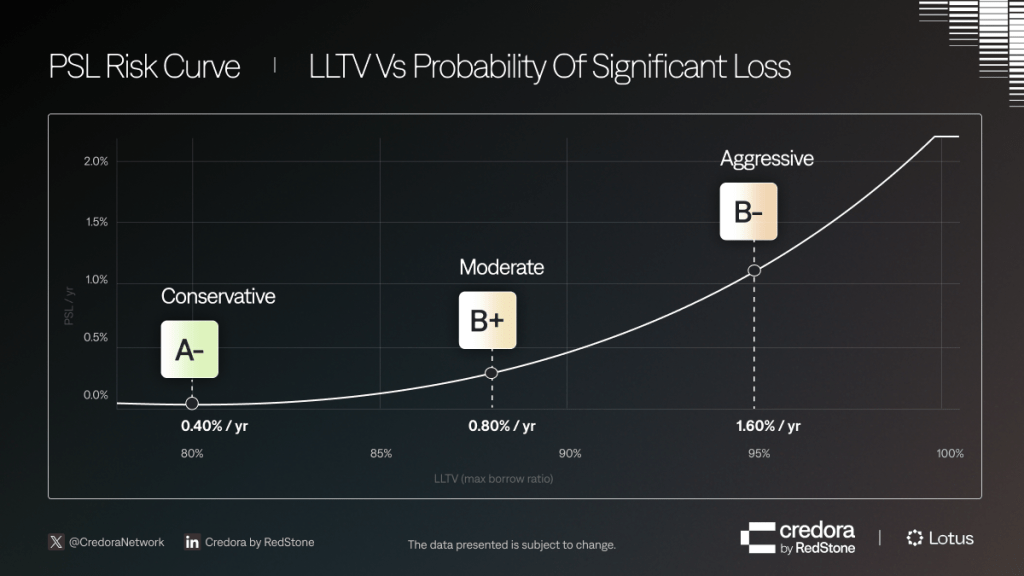
A PSL rating on a specific tranche answers one question precisely: given this collateral, this LLTV, this oracle configuration, and this borrower distribution, what is the probability that a lender in this position loses more than 1% of supplied capital over the rating horizon. That number is comparable across tranches within the same market, across different markets on Lotus, and against any other position Credora rates. The scale runs from A+ to D, with the underlying PSL available alongside the letter grade for participants who want to work directly with the probability.
What the rating does not do is equally important to understand. It does not predict when a loss event will occur. It does not guarantee precision for any specific tail scenario. It produces a modeled probability of meaningful loss under defined assumptions, and those assumptions are published. The basis for the number is visible and verifiable. That transparency is what separates a rating from a dashboard metric, and it is what allows the number to function as an allocation reference rather than a directional signal.
For a lender choosing between positions, the PSL functions the way a bond rating functions in traditional fixed income markets. You are not being told whether a loss will happen. You are being given a standardized, methodology-backed probability that allows you to compare risk across positions and build a portfolio with intention rather than approximation.
Native integration and what it changes in practice
The distinction between a rating that exists outside a protocol and a rating that is built into it is not cosmetic. It determines what the rating can actually be used for.
Most risk tooling in DeFi exists as an overlay. A protocol launches, a third-party tool evaluates it, a rating appears on a dashboard. The protocol itself has no awareness of that rating. It does not affect how the market is parameterized, how capital is allocated, or how vault managers define their mandates. The rating is informational. It lives outside the architecture.
On Lotus, Credora’s ratings are not evaluated after the market is built. They are part of how the market is designed from the first day of operation. Tranche structure, LLTV selection, and the risk curve that lenders navigate when choosing their position are all informed by Credora’s methodology before a single dollar of liquidity enters the protocol.
The practical consequences are specific. A vault curator building an allocation strategy on Lotus does not need to consult an external dashboard to understand the risk profile of a given tranche. The PSL for each tranche is available through the API from launch, with dynamic updates as borrower composition and market conditions change. A mandate that sets a maximum PSL threshold for any allocation can be operationalized directly, not approximated from external data that may lag real market conditions.
For institutional participants, this integration addresses a structural barrier that has kept large capital allocators away from DeFi credit markets. Institutions require a common risk language: standardized, methodology-backed, independently produced, and available at the point where allocation decisions are made. A native integration provides all four of those things in a way that an external overlay cannot, because an overlay can always be ignored by the protocol. Infrastructure cannot.
Conclusion
Onchain credit markets have priced yield with precision for years. They have priced default risk almost not at all. Tranched markets give risk a structure. Tranche-level ratings give that structure a language.
A lender can now choose a position on a continuous risk curve, understand the modeled probability of loss at that position, and verify the basis for that number. A vault curator can define a mandate in terms of PSL thresholds and point to an independent methodology as evidence that the mandate is being followed. An institutional allocator can evaluate DeFi credit exposure using the same conceptual framework they apply to traditional fixed income.
That combination did not exist in onchain credit markets before. Whether it matters depends on what you think these markets are for. If the answer involves capital that requires precision rather than just tolerance for uncertainty, the infrastructure now exists to support it.
Learn more about Lotus: https://www.lotuslabs.net/
About Credora: Credora provides independent, data-driven risk ratings for on-chain finance. By standardizing risk measurement across assets, lending markets, and vault strategies, Credora enables transparent, resilient capital allocation. Through quantitative modeling, stress testing, liquidity analysis, and governance assessment, Credora converts complex protocol mechanics into comparable risk signals, supporting the sustainable growth and institutional adoption of on-chain markets.
About Lotus: Lotus is a tranched DeFi credit protocol powering vaults with higher risk-adjusted yields. Lotus prevents fragmented liquidity by connecting risk tranches into one unified market, allowing lenders to access to the full spectrum of risk without sacrificing depth. Every vault on Lotus has a clear risk profile with independent vault ratings laddering up from the markets.