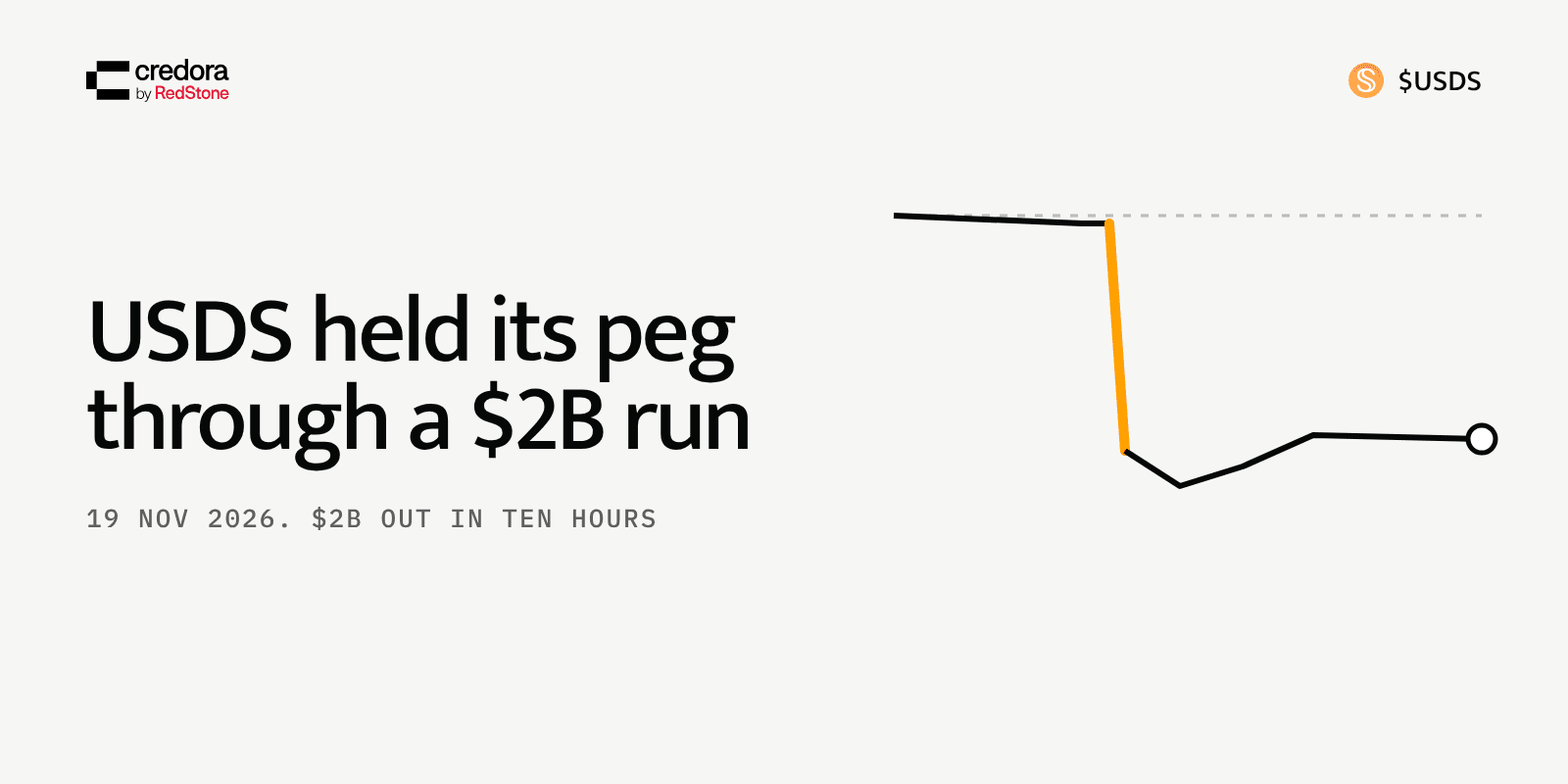
About $2B of USDC left the USDS PSM, Sky’s Peg Stability Module, in ten hours on 19 November 2026. One address took $1.49B of it in nine minutes. The peg held, and USDS ended the day more overcollateralized than it started. The instant-exit reserve fell by more than half and had not refilled by the next morning.
What triggered the run on the USDS PSM
On the morning of 19 November (US time), CoinDesk reported (opens in a new tab) on an Inca Digital study. It linked $518M of PSM flows over several years to illicit wallets, $101.9M of them to North Korea. It also noted that the PSM’s USDC sits at one address Circle could freeze. sUSDS outflows started rising from 08:00 UTC, hours before the large swap.
$518M is about 0.05% of the PSM’s $968B lifetime volume. Sky says most flagged flows came through third-party aggregators and that its own front ends block flagged wallets.
How the Sky Peg Stability Module paid out $2B
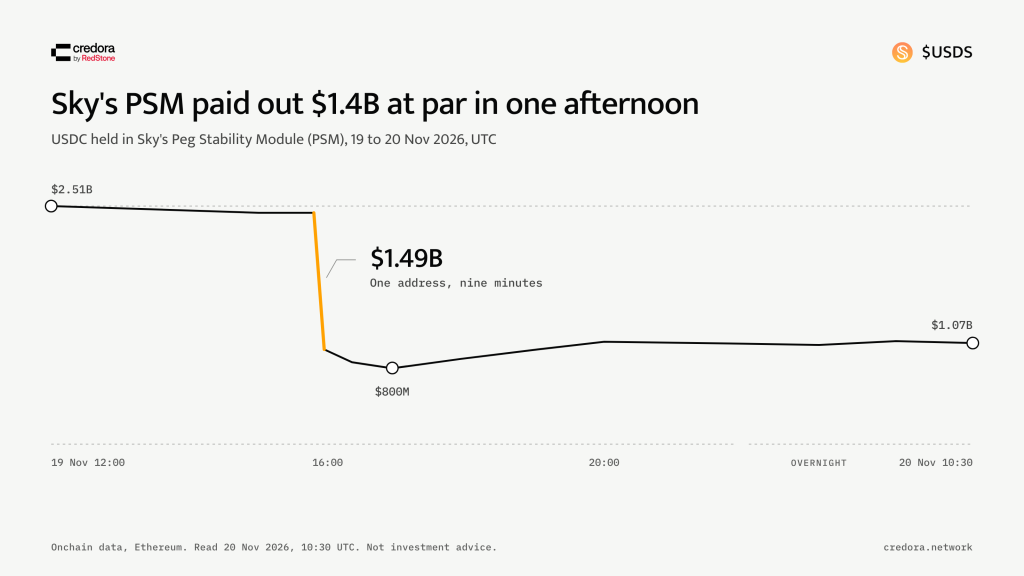
The USDS PSM swaps USDC and USDS one to one. Between 15:48 and 15:57 UTC one address swapped $1,488M of USDS for USDC in four transactions of $300M to $400M each. Of the $1,566.6M that 120 addresses withdrew from sUSDS after 14:00 UTC, this address accounts for 76%.
The PSM paid every redemption at par. Swap fees stayed at zero and nothing was paused. The savings rate held at 3.80%. At 15:00 UTC the PSM held $2.44B of USDC, enough to cover the whole swap without selling anything first. It bottomed at $799.8M at 16:56 UTC.
Why collateralization rose while stablecoin liquidity fell
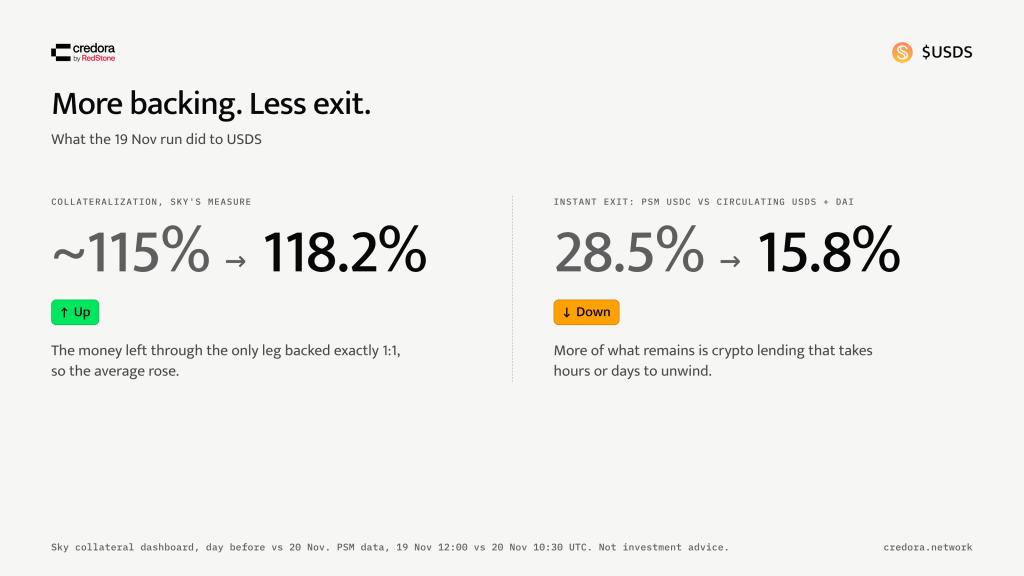
Each redemption cancels one USDS against one USDC. The money left through the only leg that is exactly 100% collateralized, so the overcollateralized crypto loans now carry more weight in the average. Sky’s own measure moved from about 115% to 118.2%, according to the Sky collateral dashboard (opens in a new tab).
Liquidity moved the other way. PSM USDC covered 28.5% of circulating USDS and DAI at noon, 11.5% at the low and 15.8% the next morning. More of what remains is crypto-collateralized lending that takes hours or days to unwind.
Who refilled the USDS PSM and who paid for it
Spark, Obex and Grove sold $437M of USDC back into the PSM between 14:45 and 19:53 UTC. Most of Spark’s $301M came from its Morpho USDC vault on Base. Obex raised $100M from a Maple redemption and Grove bridged $36M from Base. Borrowers carried the cost: utilization on Morpho cbBTC/USDC on Base reached 99.3% at 18:00 UTC. Overnight the PSM held between $1.05B and $1.08B while sUSDS kept losing about $7M an hour.
What the run means for a stablecoin risk assessment
The run did not weaken what backs USDS. Redemptions settled at par and collateralization rose. The USDS rating is unchanged as of 20 November 2026. Two inputs are under review for the next methodology update: the mint authority modifier, and how PSM liquidity depth and operational security are weighed in Sky ratings. How Credora assesses stablecoins is documented in its rating methodology.
This note does not assess Inca Digital’s attributions or who controls the address behind the largest swap. For last month’s incidents, see the October 2026 Risk in DeFi post-mortem.
Key takeaway
The USDS PSM held its peg through a $2B run and left USDS better collateralized than before. The cost was liquidity: the share of USDS that can exit instantly fell from 28.5% to 15.8% and did not recover overnight. A stablecoin risk assessment that reads only collateral ratios would score the day as an improvement. The exposure that grew is the gap between a run measured in minutes and a refill measured in hours.
This analysis is for information only and is not investment advice. Figures are read from onchain data and public dashboards at the times stated and may change.
Frequently asked questions
No. The USDS PSM paid every redemption at par, with swap fees at zero in both directions. Nothing was paused and the peg held through the run.
Each PSM redemption cancels one USDS against one USDC, the only part of the backing held exactly 1:1. With that part smaller, overcollateralized crypto loans carry more weight, and Sky’s measure rose from about 115% to 118.2%.
On 20 November at 10:30 UTC the PSM held $1,066M of USDC, enough to cover 15.8% of circulating USDS and DAI. Before the run it covered 28.5%.